I Married My 18-Year-Old Patient Knowing She Had Only Three Days Left After Her Funeral, Her Sister Handed Me a Box Alicia Had Saved for Me
“What the hell!”
Nora’s voice cracked across the cemetery parking lot like a gunshot.
A few people standing by their cars turned around to look. An older man in a black suit stopped with his hand on his car door.
I was standing next to my car with a small cardboard box open in my hands. Nora, my dead patient’s older sister, was leaning over my shoulder, staring down at the paper on top.
Her face had gone bright red.
“She left you Grandma’s money?”
She jabbed her finger at the lawyer’s letter in the box. Her voice had gone sharp and high.
“I didn’t know,” I said. “I swear to you, Nora. I had no idea.”
“Then why did you marry her?”
“It wasn’t romantic. You knew that. You were there.”
“I did know that.” Her voice broke right in half. “And now I can see exactly what you got out of it.”
She pressed one hand over her mouth.
“No,” I said. “I promise you. It’s not like that. It’s not like that at all.”
Nora backed away from me. Two steps. Three. She pointed at me with a shaking finger.
“I’m reporting you to the hospital.”
And she turned around and walked away across the gravel, her black dress whipping around her knees in the wind.
I stood there beside my car with the box open in my hands.
If the hospital believed I’d married a dying patient for her money, I would lose my job. My license, maybe. Everything I’d spent twelve years building.
I wanted to run after Nora.
I also wanted to read that number on the lawyer’s letter one more time.
I put the lid back on the box before I could do either.
My name is Lucas Ramirez. I was thirty years old that spring. I had a medical degree, a white coat with my name stitched on the pocket, and student loan payments that still made my stomach tighten every single month.
Becoming a doctor was all I’d ever wanted.
When I was nine, my grandmother got sick. A doctor at the county hospital in El Paso sat with her for an hour, holding her hand and explaining everything in Spanish, so she wouldn’t be afraid. He didn’t have to. Nobody made him.
I decided right then.
My parents couldn’t help much with tuition. My dad runs a little hardware store. Ramirez Hardware, on Mesa Street. My mom does the books for it. We were never poor, but there was never anything extra either.
So I studied all week, and I worked every weekend. All through college. All through medical school. Stocking shelves at my dad’s store. Delivering pizzas. Tutoring organic chemistry to rich kids for twenty-five dollars an hour.
By the time I finished my residency, I owed two hundred and sixty-three thousand dollars.
I had an app on my phone that reminded me every month. A little red notification. Payment due.
By the time I met Alicia, I thought the hardest part of my life was behind me.
I was wrong about that.
She was eighteen years old. She’d been on the oncology floor at University Medical Center for two months when I rotated onto her care team.
Leukemia. Acute myeloid. She’d been diagnosed the week after her high school graduation.
And she was the funniest person on that entire floor.
Even exhausted from chemo, even when she could barely lift her head off the pillow, she could make a nurse laugh while they were changing her sheets.
The first morning I walked into her room, she looked up at me from the bed.
“You’re the new one,” she said.
“I’m Dr. Ramirez.”
“Dr. Lucas,” she said. “That’s what the nurses call you. They say you’re very serious.”
“I’m not that serious.”
“Dr. Lucas,” she said, “you know smiling is free, right?”
I tried to keep a straight face. I really tried.
She waited. She just looked at me, eyebrows up.
She waited until I lost.
I saw her every day after that. Rounds at seven. Rounds again at four.
She learned everybody’s name on that floor. The nurses. The aides. The janitor, Mr. Okafor, who mopped her room every afternoon at two. She knew his kids’ names. She knew his wife made the best jollof rice in Texas.
She had opinions about everything. Which nurse gave the gentlest IV sticks. Which cafeteria pudding was edible. Which daytime talk show host was secretly mean.
Her room was covered in drawings. She drew with colored pencils on the backs of meal menus. Birds, mostly. Cardinals and blue jays and hummingbirds. She taped them all over the walls.
“I’m going to be a wildlife illustrator,” she told me once. “When I’m done with all this. I got into the art program at UT Austin. I deferred.”
“You’re very good.”
“I know,” she said. Then she grinned. “That’s a joke, Dr. Lucas. You’re supposed to laugh.”
I’d known her about six weeks when she caught me checking my phone during afternoon rounds.
It was the loan reminder. That little red notification. Payment due in three days.
“Bad news?” she asked.
“Just a bill.”
“What kind of bill makes a person look like that?”
“Student loans,” I said. “I worked every weekend through medical school. I’m still paying for it.”
She made a face.
“They should give you a refund,” she said, “for that handwriting.”
I laughed. Out loud. One of the nurses looked in the door to see what happened.
Then Alicia got quiet.
“Everybody calls you lucky,” she said. “To be a doctor. My aunt said it to you yesterday. ‘You must be so proud.’ Like you won the lottery.”
“I am proud.”
“I know,” she said. “But I don’t think they know what it cost you.”
I didn’t know what to say to that.
So I checked her IV line. And I wrote something on her chart. And I left.
Then the medication stopped working.
It happened fast. It usually does, at the end.
Her blood counts dropped. The fevers came back. The new drug we’d been counting on, the one we’d fought the insurance company for three weeks to approve, didn’t touch it.
On a Tuesday afternoon in April, Dr. Patel, the attending oncologist, sat down with Alicia’s family in the little family room at the end of the hall. Alicia’s mother. Her aunt. Her older sister, Nora.
I stood in the back.
Dr. Patel told them, gently, that Alicia likely had about three days.
Nora made a sound I’ll never forget. Like something tearing.
Afterward, I hesitated outside Alicia’s room. For a long time. I stood in the hallway with my hand on the door frame.
I had no new treatment to offer her. Nothing. And I dreaded walking in there and seeing her look up at me, waiting for one.
When I finally went in, she was propped up on her pillows. A blue jay half-drawn on the menu in her lap.
She didn’t ask me about treatment.
She asked me to sit down.
I pulled the chair up next to the bed.
“I have one last wish,” she said.
“What is it?”
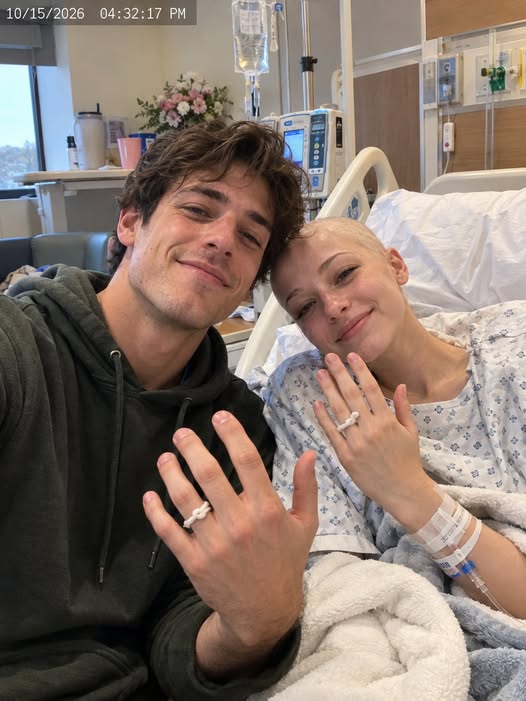
“I want to marry you.”
I thought she was joking. Of course I did.
She smiled at me. Weakly. Her lips were cracked.
“Come on, Dr. Lucas,” she said. “I don’t want to show up in heaven as an unmarried woman. My grandma will never let me hear the end of it.”
“Alicia,” I said. “I’m your doctor.”
“You’re not who I’d pick if I was marrying for love, doc,” she said.
She glanced past me, out through the glass window in the door. A nurse was walking by in the hallway. Tomás, the night nurse, who always brought her extra pudding cups.
Her cheeks went pink.
Then she looked back at me.
“But I have my reasons.”